
Linking Ohio through the power of rail
Connecting Cincinnati to Columbus to Cleveland with a 120 mph train that runs multiple times a day may become a reality if All Aboard Ohio has there way and the implications could be significant.

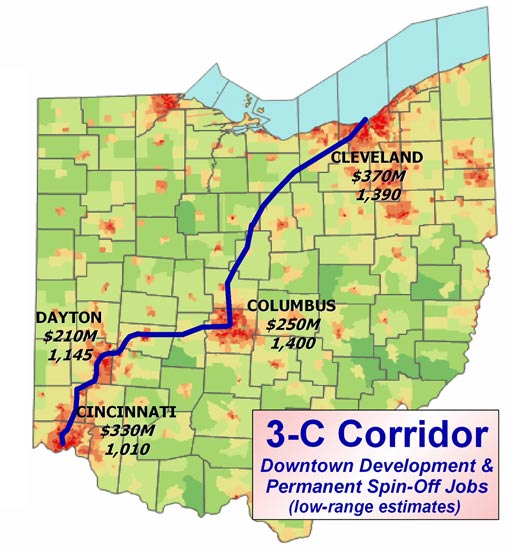
Imagine traversing the state of Ohio with an array of high-speed trains connecting Cincinnati to Dayton, Columbus and Cleveland at speeds of up to 110 miles per hour (mph) within the next 10 – 15 years. That’s the goal of All Aboard Ohio, a non-profit advocacy group working to establish a modern, consumer-focused, statewide passenger transportation network that provides Ohioans with safe, efficient and cost-effective travel choices.
Initial goals set by All Aboard Ohio include reintroducing rail transit between Ohio’s three major metropolitan areas. Dubbed the 3-C Corridor, the new transportation route is part of the Ohio Hub plan and would impact nearly two-thirds of Ohio’s sizable population with an alternative, cost-effective and speedy mode of transport connecting the state’s Northeast and Southwest corners.
At the present time Ohio is moving forward with its plans as the U.S. Department of Transportation (DOT) develops the details of its new passenger and high-speed rail development program. This will be reviewed by Congress and was initially funded by $8 billion from the stimulus. President Obama has since proposed $1 billion per year for high-speed rail development in his transportation budget.
 The Ohio DOT is moving forward with a study by Woodside Consulting Inc. that will simulate railroad traffic flows along the 3-C Corridor and plans to apply for stimulus funding, for the 3-C Corridor, as soon as that study is complete which is expected to be this July. If ODOT were to win a stimulus grant Ohio law requires that a supermajority vote (5-2) of the State Controlling Board be given before funds are used to acquire property for any rail project – this approval is not guaranteed as Republican protests have filled much of the discussion on this topic.
With a population density greater than that of the country of France, 8.5 percent of Ohio’s households live without a car with greater percentages seen in urban centers like Cincinnati and Cleveland. Additionally another 13 percent of Ohioans are over the age of 65. As baby boomers continue to age, that number is expected to grow to 20 percent of the state’s population by 2030. Ken Prendergast, executive director of All Aboard Ohio says that when you combine those two demographics you have about a third of the state’s population in need of a long-distance transportation alternative to the automobile.
Prendergast imagines the 3-C Corridor starting out with eight to ten daily round trips traveling at average speeds of 80mph making a trip between Cincinnati and Cleveland 3 hours and 15 minutes compared to roughly 4 hours by automobile.
In addition to the time savings, riders would also benefit from cost savings. AAA estimates that a typical sedan costs $0.70 per mile to operate whereas the average Amtrak ticket cost in the Midwest weighs in at only $0.15 per mile. With this existing pricing model, a trip between Cincinnati and Columbus would cost a passenger just under $40 round trip.
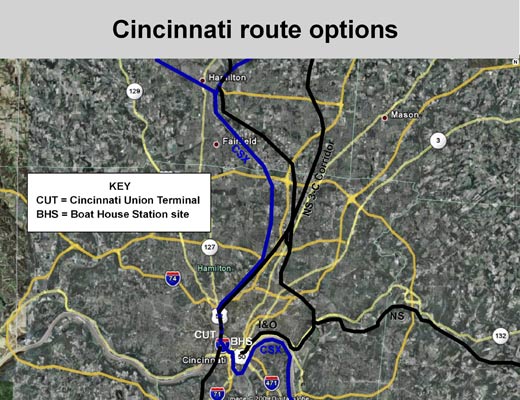 Discussions of potential station locations are still being discussed, but in Cincinnati a recent study shows that although Union Terminal is currently one of the busiest freight yards in the nation, routing passenger rail service is tricky because there are no remaining right-of-way rails for additional traffic. Building additional rail lines could be costly.
Prendergast suggests a less expensive alternative could include an eastern approach that would utilize the existing Oasis Line. This route would require track upgrades but would improve track reliability, speed and reduce initial start up costs.
A station could then be located near the Montgomery Inn Boathouse or even the underused Riverfront Transit Center if it is determined that the facility could support such a system.
The approach to implementing this type of high-speed rail system here in Ohio will be similar to the approach used elsewhere throughout the country. The furthest along in the process is California where state leaders have systematically invested in their rail infrastructure to provide the necessary upgrades to offer high-speed rail service of up to 110 or 120mph.
In Ohio, travelers will initially see a system with peak speeds of 80mph due to regulations that require signaling systems to be in place for any system that travels over that speed. Prendergast calculates starting at lower speeds will reduce start-up costs from an estimated $2 billion to the current $250 million proposal on the table.
In Illinois, the state transit system is currently running five daily round trips at an average speed of 79 mph. They are in the process of increasing that service to eight daily round trips at top speeds of 110mph throughout the state. “They’ve spent hundreds of millions of dollars already and built up a track record with the feds,” says Prendergast.
In the end the high-speed rail service could dramatically change the way Ohioans move and live their lives. “If it’s part of an overall transportation system that include buses, light rail, intercity trains and streetcars that connect Ohioans to airports and job centers as a whole network it will be attractive to young people and our city centers will be much more dynamic,” states Prendergast.
Prendergast goes on to say that this is something that will help connect the poor and working class to an affordable means of quick and reliable transportation that has not existed here before. Additionally, Ohio’s economy and environment will benefit from the reduction in automobile traffic while making the state more attractive to talent seeking transportation alternatives.
“We need to do this in Ohio to keep our cities vibrant…otherwise more than a third of our population will be left out,” says Prendergast.
Related Articles

Interfaith coalitions drive sustainability across region with climate action
Cincinnati initiative “Faith Communities Go Green” allies with houses of worship to put diverse religious teachings into practice.

Greater Cincinnati Society of Professional Journalists and Ohio’s Best Journalism recognize Soapbox for excellence in 2025
Solutions journalism reporting about health, social justice and environment earn top honors.

Beyond the runway: Goodwill and UC DAAP explore fashion’s circular future
A cross-sector collaboration between Cincinnati organizations turned discarded textiles into a conversation about fashion’s future.