Blog

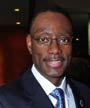
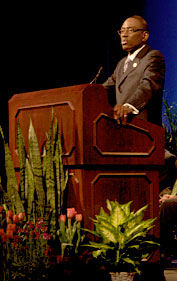
Guest Blogger: Mayor Mark Mallory

Mark Mallory was sworn in as the 68th Mayor of the City of Cincinnati on December 1, 2005.  Mayor Mallory’s election marks the first time in over 70 years that Cincinnati has elected a Mayor who was not previously a member of City Council.  Mallory is also the first directly elected African American Mayor in Cincinnati’s history.  The Mayor took office focused on changing the way that business is done at City Hall to make it more accessible and citizen-friendly.

Mayor Mallory is a life-long Cincinnatian, born and raised in the West End. Before being elected Mayor, Mallory served in the Ohio General Assembly for nearly eleven years.  In 1994, he was elected to his first of two terms in the Ohio House, replacing his father who retired after three decades in the legislature.  In 1998, Mark Mallory defeated an incumbent Senator to be elected to the Ohio Senate.  Mallory served in leadership for most of his tenure in the legislature and rose to the position of Assistant Minority Leader of the Senate.

As Mayor, Mallory is using his skills at relationship building to create a collaborative spirit at City Hall that brings people together across party lines to address the needs of the city.  Mallory’s reforms have lead to more orderly and efficient City Council Meetings.  In his first term, the Mayor’s priorities include enhancing public safety, encouraging strong economic development, improving public transportation, strengthening neighborhoods, and protecting the environment.

In his first two weeks in office, Mallory fulfilled his promise to work across party lines by passing a budget with support of all three Cincinnati political parties.  The budget puts more police officers on the streets, supports a new firefighter recruit class, funds local Arts, and invests in neighborhood improvements; all while cutting property taxes.  Through the budget process, the Mayor was praised for the unprecedented level of teamwork with City Council in developing a budget that for the first time in recent memory did not require extensive debate and modification.

Mayor Mallory also serves his community outside City Hall on the boards of several community organizations.  Since entering public service, Mallory has received numerous “Legislator of the Year” awards and “Public Service” awards for his commitment to serving the people of Ohio.


SoapBlog 2 - The 2010 Census
Posted By: Mayor Mark Mallory, 3/8/2009
SoapBlog 2: The 2010 Census
Mayor Mark Mallory


In my State of the City Address, I talk about the importance of the upcoming 2010 Census count.

The Census is one of the best opportunities to bring new financial resources to Cincinnati.  Each year, 170 federal programs use Census data to distribute $300 billion in funding.  In addition, 80% of decisions about where retail stores open businesses are based on Census derived data.  At the time of the last Census, the US Conference of Mayors estimated that a city loses $2,263 over a decade for each person not counted.  By those numbers, Cincinnati missed out on $104 million. 

The reason we lost so much money is because as many as 46,000 people who were living in Cincinnati were not counted in 2000.  We now know that Cincinnati's population is 378,259.  That number is the result of a comprehensive analysis we commissioned from Social Compact, a national non-profit organization that encourages private investment in inner city communities.

Social Compact conducted a DrillDown study of Cincinnati that used 27 different types of data to project Cincinnati's actual population and true income.  The study showed that Cincinnati's population has been undercounted by the Census Bureau by as much as 46,000 people, and revealed $2.7 in previously unrecognized income.  We are using those income findings to recruit business investment to our 52 neighborhoods through my Shop 52 initiative.

As we approach the Census, the DrillDown study is a huge asset that gives us a competitive advantage of many cities.  In 2010, armed with the number 378,259, we know how many people we are looking to find.

Instead of counting people, we are accounting for people.  That new mindset will allow us to be much more targeted in our approach.  If for example, a neighborhood is counted and we find fewer people than we expected to find, we will know that we need to invest more time in that neighborhood to find people who may not have been easily identified the first time.

Last year, I created a Cincinnati Complete Count Committee to develop a comprehensive strategy to ensure Cincinnati has the most accurate count possible.  The committee is composed of over 100 local leaders and co-chaired by Charles Graves, Director of City Planning, and Donna Jones Baker, President and CEO of the Urban League of Greater Cincinnati.  We are going to undertake the most comprehensive effort ever seen in Cincinnati to find and count everyone who is living in our city.

We need your help.  We need you to spread the word about the importance of the Census.  We also need your ideas.  Give us your suggestions on how we can get the word out to people.  Together, we are going to literally grow our city next year.
 
SoapBlog 1 - Cincinnati Streetcar
Posted By: Mayor Mark Mallory, 3/3/2009
SoapBlog 1 - Cincinnati Streetcar
Mayor Mark Mallory

I want to thank Soapbox for the opportunity to be the guest columnist this week after my State of the City Address last Wednesday.  It will be a great opportunity to expand on some of the key priorities that I discussed, and hopefully, get some great feedback and spark further discussion.

Let's start with the topic that got some of the loudest applause at the State of the City and has also drawn some of the harshest criticism: The Cincinnati Streetcar.

In the address, I made it clear that the Streetcar is absolutely crucial to the future of Cincinnati.  Over the last few years, we have moved forward on major projects all over the city.  
  • The Banks is rising out of ground.
  • The construction of the new Riverfront Park is underway.
  • We are building a new tallest skyscraper, the Great American Building at Queen City Square.
  • Over-the-Rhine is undergoing a dramatic transformation with new businesses, hundreds of new condos, a beautiful new school, and expanded park.
  • And in Uptown, we are seeing lots of new development around the University and hospitals.
The Streetcar is the project that links them all together and fuels the next round of development.

Now, some have suggested that we cannot do all of these projects at once.  I reject that notion.  Across the country, the cities that are seen as thriving, growing, and hot, are the cities that are doing big, bold, dynamic projects.  We are no different in Cincinnati.  In fact, we have a history of tackling big projects that have shaped our landscape and made Cincinnati such a vibrant city.

The other criticism that is leveled at the Streetcar plan is that it diverts millions of dollars from neighborhood projects.  The truth is that much of the funding for the Streetcar will come from non-city sources, including state and federal funding and private investment.  That funding is only available for a big transit project such as the Streetcar.  It would not be available for other projects if we do not build the Streetcar.  It would simply vanish.

However, rather than divert funds from other neighborhood projects, by generating as much as $1.4 billion in investment from the first phase alone, the Streetcar will generate increased tax revenue that will be available to spend on programs and projects that will benefit every neighborhood in the city.  The increased revenue will help provide more police officers and fire fighters, more money for garbage collection, more money for street repair, more money for parks and recreation, and more money for everything that makes Cincinnati a special place to live.

As I said in the State of the City, the Streetcar will have a dramatic and lasting impact on the future of Cincinnati.  It will grow our local economy by spurring economic development by creating new jobs.  We have a history of big projects in Cincinnati, and we need to embrace that history and chart a course for a vibrant future for our city.

Now, let me know what you think.  We are always looking for feedback.  Hopefully, you are a Streetcar supporter, but if not, I am looking forward to making our case and winning your support.