
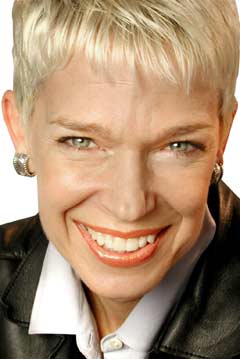
Carol Coletta is president and CEO of CEOs for Cities and host and producer of the nationally syndicated public radio show
Smart City.
Before moving to Chicago to head CEOs for Cities, she served as president of Coletta & Company in Memphis. In addition, she served as executive director of the Mayors’ Institute on City Design, a partnership of the National Endowment for the Arts, U.S. Conference of Mayors and American Architectural Foundation.
Carol is a passionate advocate for cities, and she has devoted her life to answering the question: What makes cities succeed? Since founding Smart City in February, 2001, she has interviewed almost 600 international urban leaders. Through her weekly conversations on Smart City, her research and consulting, and now as leader of CEOs for Cities, she continues her ongoing quest for the answers.
Among her accomplishments, Carol created and hosted the Memphis Manifesto Summit with Richard Florida, the first gathering of the creative class to write their call to action for cities; with economist Joe Cortright she developed a series of papers on talent, where it moves and why; she conceived and wrote the Talent Magnet Report, the first city blueprint aimed at attracting and retaining the creative class; and she co-authored Cultural Development in Creative Communities for Americans for the Arts.
Carol was a Knight Fellow in Community Building for 2003 at the University of Miami School of Architecture. Her paper on the Future of Cities, produced for the University of Houston Clear Lake’s Future Studies program, was selected for presentation to the World Future Society annual meeting. She is currently a candidate for a Master of Design Methods at the Institute of Design at IIT. She is frequently interviewed as an expert on urban issues by national media and is an active speaker on the success formula for cities and creative communities.
This year she was named one of the world’s 50 most important urban experts by a leading European think tank.
Soapblog 3
Posted By: Carol Coletta, 6/5/2008
Here’s a surprise: The most politically active Americans now believe that we cannot have a strong nation without strong cities. Whether they are Republicans or Democrats, city dwellers or suburbanites, Americans are now convinced that cities are key to solving the problems our nation faces.
According to political pollster Celinda Lake, this belief is so strongly held, it has transcended belief to become a value. For someone who’s been at this work since the mid-70s (when I was trying to get downtown Memphis going again), this feels like a real triumph. (In my arrogant moments, I feel it confirms that my belief in cities was right all the time.)
Americans view cities as the means to keep America competitive in a global economy with a continuous stream of innovations; the best places to give people access to jobs and opportunities; the places where culture comes alive for locals and visitors alike.
Political donors are even willing to punish politicians who don’t support cities.
Now that Americans believe cities are more important than ever before, is Cincinnati ready to take advantage of that? Are there visible reminders that Cincinnati is the source of innovation in the region, the best place to connect people with opportunity? Does Cincinnati embrace its urbanity? Is Cincinnati connecting with America’s new values?
If not, you are missing the best opportunity cities have had for success in 50 years.
Soapblog 2
Posted By: Carol Coletta, 6/4/2008
“Everything you know about cities is wrong.” That could have been the theme of CEOs for Cities national meeting last month in Pittsburgh.
“Sustainable Urbanism” author and urban planner Doug Farr challenged the popular idea that global warming will be solved with technical fixes. In fact, they are not nearly enough. Instead, the most important contribution each of us can make to reverse climate change is to get out of our cars.
Driving less is not always easy in cities like Cincinnati. As Doug points out, individuals can only make so many adjustments. Then they need help from planning departments and transportation planners to do the right thing.
The formula for driving less is straight forward: Provide mixed use neighborhoods of approximately a quarter mile radius where people can walk to meet their daily needs and connect them to other neighborhoods with densely developed transit corridors.
Doug gave us what first appears to be an audacious challenge: Reduce Vehicle Miles Traveled (VMT) to 1970 levels or 3900 miles per year by 2030. But on further reflection, life was pretty good in 1970. It’s not as if we are all feeling deprived that we couldn’t drive our Mustangs farther. (I know. I remember. And yes, mine – or more accurately, my dad’s – was red.)
So what is your VMT, Cincinnati? And what kinds of changes will you demand from your planners and politicians to help you achieve this goal? With gas pushing $4 a gallon, if we can significantly reduce our driving, we will end up with more money in our pockets, as well as a better environment.
Soapblog 1
Posted By: Carol Coletta, 6/3/2008
CEOs for Cities, a national network of urban leaders, including a number from Cincinnati, who are creating next generation cities, gathered two weeks ago for its national meeting in Pittsburgh. It was provocative and surprising from start to finish.
The first big surprise was Pittsburgh itself. Most of our members had never been there, and if they had, it was a long time ago. What they found was a city with an appealing downtown, high usage of its public transit system (buses only, by the way), vibrant in-town neighborhoods, a connected, people-friendly riverfront, and plenty of construction underway.
What they didn’t find were steel mills and polluted air. Although Pittsburgh still loves its Steelers, it is no longer Steel Town. In fact, Pittsburgh has now shed all of the manufacturing jobs it’s going to lose, and the city is left with an economy built on advanced manufacturing, eds and meds. With Carnegie Mellon and the University of Pittsburgh leading the city’s array of universities (and with Google’s new offices there to take advantage of the tech talent), the city is well positioned to thrive in the knowledge economy.
The two biggest worries for Pittsburgh, in my view, are the drag on its future vision that the past continues to exert and the fact that Pittsburgh is far more white than is healthy at a time when diversity matters at all levels.
Are there lessons here for Cincinnati?