
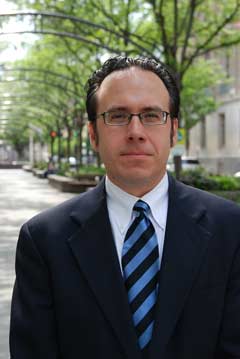
Casey Coston, an attorney at Squire, Sanders & Dempsey, L.L.P., in downtown Cincinnati, focuses his practice in the areas of insolvency, creditors’ rights, bankruptcy reorganizations, out-of-court workouts and restructurings. He has considerable experience representing creditors’ committees in Chapter 11 cases throughout the U.S., as well as debtors, financial institutions and trustees. He has represented both debtors and creditors in reorganizations nationwide in a variety of businesses, including energy, real estate, automotive suppliers, retail and steel production.
Mr. Coston is published in the Journal of the American Bankruptcy Institute on a variety of bankruptcy related topics ranging from preference defenses and intellectual property to the intersection of environmental issues and the bankruptcy code. In addition, prior to moving to Cincinnati, he was a regular contributor to the Metro Times, a widely circulated weekly newspaper in metropolitan Detroit, for which he had written recurring columns on topics such as urban renewal and historic preservation, business development strategies, music and the fine arts and just about anything else that popped into his head at the moment.
Soapblog 3
Posted By: Casey Coston, 5/22/2008
I was struck by a recent news report detailing an exchange Mayor Mallory had with a woman at a Colerain Township car wash in which she confessed, in all seriousness, that she would visit downtown if there weren’t “so many bodies piled up in the streets.” As the mystified (mortified?) Mayor listened further, the woman confessed that she had not been downtown in seventeen years.” Seventeen. Continuing in a similar vein, I sometimes read with bewilderment articles on such phenomena as the “Streets of West Chester,” and fawning local media coverage that makes exclamations like "it's just like a real downtown!” (as if this is some newfangled utopian discovery or Disney theme park). Such hyperbole often leaves me scratching my head, primarily because…um…we already have a downtown, and it's definitely not in West Chester. The residents of this region need to realize that the tired and outdated clichés of the past no longer serve anyone’s interest. But one parallel I can draw from my former stomping grounds in Detroit and here is that the region, both city and suburbs, all need to realize that we are in this thing together… every place has inherent assets and attributes (based on the Mayor’s lead, Colerain must be a great place to get your car washed), but everyone needs to recognize that a doughnut is not the ideal model for a thriving and successful metropolitan region. Downtown is not replicated in the suburbs. Each has a place, but one does not replace the other, and everyone needs to recognize where the heart of the region is located (if you need a hint, look for the tallest building).
There is a kind of “ripple in a pond” effect that can be taken right down to the tiniest microcosm, to a single block in the city, to Fountain Square. To quickly paraphrase, one theory behind investing in the reconstruction of Fountain Square is that, in so doing, the success there will ripple outward, to adjoining blocks, leading to more development, more investment, more buzz. Based on what I have seen, it has been an unparalleled success. Take the same theory and apply it to the Gateway Quarter in OTR and see the effects ripple outward, to the new residents, the retail stores and restaurants on Vine. Do the same thing on the Banks and on Washington Park. Now extrapolate that same theory to the concept of a city and its suburbs, as the success of the city will inherently ripple out and equate to healthier suburbs. While “synergy” is an odious and oft-overused buzzword, it does have a place in the dialogue, and at its most base level, it involves working together and cooperating, not the city-suburb trench warfare that I witnessed in Detroit, and not the 52-card-pickup neighborhood Balkanization (some might call it “Banksanization”) that sometimes rears its ugly head here (for recent examples, see east v. west debates on streetcars in OTR; section 8 housing on the Banks, etc.).
In short, to paraphrase the cloying, yet catchy, Ben Lee song currently being co-opted for a Kohl’s TV commercial, “we’re all in this together.” Although the natural cynic in me would dismiss such hollow sloganeering as trite, superficial pabulum, it actually works at a base level. Whether you are at the carwash in Colerain, the “Streets of West Chester,” Hyde Park Square or OTR…we’re all in this together. Spread the word, and if you haven’t been downtown in 17 years, I dare say you might be surprised by what you see. Just the changes that I have seen in my short five year tenure have been considerable, and the momentum is certainly heading in the right direction, something which is not the case for every city these days. In any event, it appears that I have reached the end of my rambling scattershot of anecdotal platitudes and homespun homilies. I will now step down and relinquish this Soapbox to allow the next blogger to climb on up. Viva Cincinistas.
Soapblog 2
Posted By: Casey Coston, 5/21/2008
After logging almost five years in Cincinnati, and coming from a region so utterly (and painfully) dependent on the automobile and freeways, it is still amazing to be able to move into an affordable city with such diverse and dynamic neighborhoods within ten miles and less of downtown, all with a seemingly abundant stock of historic preserved architecture, gas lit streets, thriving localized commercial districts, and lush park-like settings. While many other cities have areas like this, they oftentimes refer to them as “suburbs.”
Many commentators attempt to paint this city with a pretty broad brush (‘it’s conservative,” it’s boring,” “um…did I tell you it’s conservative?”), however we have found our neighborhood of North Avondale to be incredibly diverse based on any metric you might care to examine. I realize that is not the case everywhere in the city, but I also know that this is not an isolated example, and I am still surprised as to how this message is continually drowned out by the tired old knee-jerk mantras that seem hopelessly outdated in modern-day Cincinnati. It still confounds me how many out of town friends who have never been here mention the Mapplethorpe imbroglio as an ice breaker. What this tells me is how few people really know this city. Moreover, many of these people actually live in the region. That’s why a Soapbox is as good a place as any to spread the word.
During our relatively short time here, the incredible wealth of arts and culturally diverse activities, coupled with the sustained progress downtown, all within a five or so mile radius from our home, has continually left me slack-jawed in amazement. My older son goes to a phenomenal public high school (Walnut Hills) ranked in the top 35 in the nation, and only two miles from our driveway. My younger son goes to a neighborhood Montessori school ("The New School") which is even closer to our home and is truly a gem in the city. The nearby and much sought after public Montessori elementary school just down the street is also very highly regarded. These are major Q of L factors, and coming from a region where even the most mundane of quotidian routines required an automobile expedition along the likes of the Paris-Dakar rally, any opportunity to spend less time in the car is a very good thing. Moreover, as discussed in greater detail in last week’s Soapbox [link], some now contend that the precipitous rise in gas prices has helped to make the investment in a home in the city more attractive vis-à-vis the suburbs.
Oftentimes, when speaking to friends and colleagues from Detroit (or New York or Chicago, for that matter), I refer to Cincinnati as “the 10 Minute Miracle.” Coming from the Metroit area, where a trip almost anywhere (work, schools, dry cleaner, bathroom) entailed untold hours in the car, I have now found that, from my centrally located neighborhood, I can literally be almost anywhere in basically 10 minutes or less… truly a revolutionary concept that should not be diminished.
I must admit, while we would never consider moving out any further than the “far flung suburbs” of North Avondale (at least that is how it was considered in the 1890’s), we can clearly envision moving much closer to downtown. Moreover, with the (hopeful) advent of the much ballyhooed streetcars, the ability to convert to as car-free a lifestyle as possible would be a monumental advancement for the city as well as the entire region.
On that point, the recent streetcar debates at city council revealed telling loyalties in a city which can, at times, appear to be made up of 52 widely divergent interests. Indeed, advocates for one neighborhood appear to view an investment in downtown and OTR as taking away their neighborhood’s slice of the pie, kind of like a reverse-NIMBY (not in my backyard) syndrome. While this type of myopic thinking is, regrettably, oftentimes an impediment to real progress, to use an oft-repeated maxim of politics generally attributed to the late Tip O’Neill, “all politics is local,” and with 52 different neighborhoods, Cincinnati has a whole lot of “local.” Nevertheless, navigating such obstacles, while at times Byzantine, is not impossible, and, for example, the recent and modest success in the streetcar debate demonstrates what can be accomplished with capable leadership and vision. In any event, (I see my time is up…the red light is blinking), I will try to touch upon this in greater detail in my next post.
Soapblog 1
Posted By: Casey Coston, 5/20/2008
As a transplant to Cincinnati from the Detroit area, I am often asked for comparisons between the two cities and regions. For the most part, it is a conversation about apples and oranges in which I choose not to indulge for fear of being unduly negative on my much beloved, yet undeniably dysfunctional, former home. After ten years in Detroit, both as a practicing attorney as well as (in my rare free time) a free lance writer, I often traversed and chronicled the city’s peaks and valleys (metaphorically speaking, as that city’s pretty much as flat as the proverbial pancake), its architectural treasures, its indomitable and brilliant creative spirit, its lost history, its sometimes halting renaissance. As a 139 square mile city which has been depleted of a big chunk of its inhabitants following the peak years in the 1950’s, Detroit has doggedly endured as the rusting arsenal of democracy, a scarred but jarringly beautiful post-apocalyptic industrial landscape, continually beating down the lengthening shadows from a more prosperous time. It is a city that, literally as well as figuratively, is the modern acropolis of America's post-war manufacturing might, and which, in its more prosperous times, paved under some of its most treasured and culturally rich neighborhoods in order to build the freeways that enabled its population to quickly flee for the suburbs.
Oh wait…I thought I wasn’t going to be negative.
Anywho, when an opportunity surfaced in Cincinnati, both my wife and I were receptive, despite the fact that we had no friends or relatives or any other tangible connection to the city. What we did see, however, was the opportunity to relocate to a city with a much denser fabric, a city which would reconnect us with our urbanist inclinations (let’s just put our biases on the table right now); an opportunity to live in a city without 30 and 40 minute commutes…where travel mugs are a thing of the past. I’m not saying it’s Chicago or NY, it’s not; but that’s not what we were looking for at the time. Cincinnati is, among many other things, a relatively manageable and affordable Midwestern city with a wealth of historic architecture, fine arts, diversity, natural beauty and a decent level of density in and around the urban core, all uniquely Cincinnati (not to mention, at least for the time being, an airline hub).
After an initial foray during an icy weekend in February, within a week or so we were putting an offer down on a house and preparing to slough off our motor city shackles. As we trundled down I-75, we grew giddy with anticipation, ultimately plunging head first into a new city which was heretofore virtually an unknown [cue the swelling bombastic music] embracing our new status as [crescendo], um, well…. “Cinsters?” No, awkward… “Cincinistas”? Perhaps, yes…a touch more revolutionary, yet softened, ever so slightly, by the inherent, vaguely Southern politesse so prevalent in the Cincinnati ethos.
Although it is something of a cliché, an oft-invoked observation I tend to hear around town is that “the biggest naysayers about Cincinnati are the natives.” Having read many comments and letters to the editor, as well as what I have experienced in daily conversation, I would say that this is, unfortunately, a truism in many respects. Sad but true, but, then again, what's the use of a soapbox if you can't preach the gospel? Conversely, it also seems that some of the more recent rah-rah Cinci-Yay boosters seem to be transplants (guilty as charged), who arrive free of the pre-existing historical baggage and jaded notions which may pile up in the closets of some (but not all) long-time natives. So I'm here to preach my own gospel of the Cincinista, Elmer Gantry style, from the virtual Soapbox© blog. Let me note for the record that, while I realize it’s not all rose colored Polyanna glasses and such, this is not intended to be a comprehensive treatise, so I suspect my observations from high atop Mt. Soapbox will generally skew towards the positive, at least initially.